Monday, December 10, 2018

Winter Arrives Early

Regardless of the timing, winter brings a change in prominence of the locals.  The non-snow birds disappear, leaving others behind to be better noticed.  In particular, as long as all the water is not completely transformed to a solid, a variety of interesting critters provide entertainment.

There are plenty of scrumptious weeds under the moving water.
The geese are more welcome at this time of year
because they are not keen on defecating everywhere one walks.


The male hooded merganser also likes the water.
A bit skittish, he has yet to provide the photo op desired,
where individual feathers are on display.


Unlike the chickadees, who are paid models.

For a few black oil sunflower seeds,
they're more than happy to pose.

And to provide motion studies.


The herd heard there was food next door.

This charm of goldfinches did not need to go that far.


What should you call beavers without flat tails?
You oughtta call them otters.

Backlit and in the shade,
he provides a fine silhouette,
but the subtleties are lost in the shadows.

But he doesn't care.
He's having fun.
Otters always look like they're having a good time.


Sharp-eyed Mary spies a large bird in the treetops.
Who could this be?

Correct!
The American Bald Eagle watches from the treetops.
Come closer!


Oh yeah!
A visit to the water's edge
provides a more detailed pose.

The wind and driven snow are giving someone a bad feather day.


No matter.
The regal pose is recovered.


Now where did I put my cell phone?


Regal once again,
even if the talons don't penetrate the ice or granite.
(And there were no messages.)


Monday, November 5, 2018

Action and Reaction Upon Lack of Traction


One of the most dangerous tools ever devised is the chain saw.  It is a wonderful labor saver, but must always be treated with healthy respect.  Its capacity for unanticipated mayhem is unsurpassed.  Not only is it a magnificent creator of sawdust, but it is also a machine that changes the dynamics of large objects we expect to be intransigent much more quickly than our minds appreciate.

And every once in a while, it kicks back at its user to exact first hand revenge.

But for all these things, good and bad, it needs a chain with sharp teeth.  Hand sharpening can improve the saw, but when performance declines to the point of acting more as a sander than a cutter, it's time to go get a replacement.  

There were multiple logs to be cut into firewood, so Russ volunteered to drive down to Zipp Hardware.  We were about half way there when it was noticed that we'd forgotten to throw in the gas cans that would insure that we could get the job done.  

"Better go back and get them."

"I guess so."  So we delayed our arrival in downtown Dolgeville by 20 minutes or so. 

Good for containing gas.
Not so great for pouring it.


Ya gotta love Zipp Hardware.  It's a real old-fashioned hardware store, with real people who actually know things about tools and hardware.  Once upon a time I went there with my friend Bob to get a 1" diameter piece of copper pipe.  Rarely used these days, we were skeptical that the store would have the pipe we needed to get the camp waterworks back in order, and as suspected, there was none in the store.  But one of the owners said, "Follow me," hopped in his truck, and drove 2 blocks to his house on the outskirts of Dolgeville.  We followed and waited while he rummaged around in the attic of his garage.  He emerged with a 4 foot length of 1" copper pipe...enough to do the fix twice.

Amazed at the service, Bob whipped out a $20 and held it out to the man.  "Naw... Put that away.  I've been meaning to throw it out for some time.  You saved me the trouble."  Can you imagine that happening at Lowes or Home Depot?

A great place.
Certainly, they have something you need.


This time, what was needed was in stock.  Anyone needing a chain with sharp teeth later in the day was out of luck, because I took all 3.  Good teeth are important.

Then off to fill the cans at Stewart's, the combination gas station, convenience store, and ice cream stand.  Magnanimous Russ offered to do the fill, since his truck was also in need, and he began with one of the cans.  

"Wait a minute.  What gas did you put in there?  We need to get the higher octane version with no ethanol for the small engines."

"Oops!"

"No matter, I'll dump the can into the truck."  So Russ filled the other can with the good stuff while I emptied the full one into the truck.  The damn "spill proof" nozzle did not fit well into the truck's filler neck, so of course, I spilled all over before the gas in the can went down to a more manageable level.  All the while, there was another truck behind us waiting to pull into the space at the pump while we did our keystone cops routine.

Self conscious about the delay, with the can finally empty and Russ refilling it and topping off the truck, I wandered back to the truck behind and motioned the driver to roll down the window with an outdated cranking gesture.

The window came down and revealed two young guys in the cab.

"Yeah," I offered.  "We're idiots.  Sorry about the delay."

"No problem, man.  We're on our phones, so no hurry."  A good use of technology.

Russ was finishing up, so I hopped back into the passenger seat.  Not being of the same generation as the guys in the truck behind us, accessing the cloud did not occur to me.  I stared a the steel trestle bridge across East Canada Creek, on which we would shortly begin our return.  As I observed without purpose, an 18-wheeler flew down the hill on the other side much faster than any reasonable operator would attempt.  The right hand turn onto the bridge would have been easily negotiated with half the current inertia.  Frozen and fascinated, I watched as the westbound semi crossed into the eastbound lane and began disintegrating as it tipped into the massive steel triangles of the bridge.  The cab came to rest halfway to the other side.

A few seconds prior,
just another boring day
for the bridge over East Canada Creek.


The destruction of the vehicle seemed to unfold slowly, even though the impact and destruction certainly were quite sudden.  Time was stretched while pieces of what looked like foam insulation and metal fell into the stream below.  Much later, I wondered if I would have reacted at all if my viewpoint had been much closer.

The effect of the bridge on the vehicle was remarkably like that of a gigantic grater on a long block of cheese.  Little pieces of the truck were skived off, dropping to the water below.  Each blade took a little more as the giant provolone was reduced by half.

Bad day for Old #106
Gotta wonder how long it took to get the bridge back in service.


Feeling the need to help if possible, I hopped out and began walking toward the bridge, not looking forward to what I might find in the cab.  The driver waiting behind us was right behind me, saying, "Man, that guys job is over!  He'll never work for that company again."  My thoughts were similar, but not for the same reasons.  Oh, to be young and immortal again.

As we approached, the remnants of the front windshield fell forward, and out of the now-vertical opening popped the driver.  Soon on the bridge, I asked, "Are you OK?"  He said nothing and turned away.  There was a cut on his hand, and his sock was bloody, but in light of what had just happened, he was in great shape.  I had to wonder why he would ever drive the rig with no shoes.

That's the driver on the left.
He may be stupid and careless, but his luck is enviable.


The town came alive, and very quickly there were crowds of people watching from both sides of the bridge.  It could not have been more than a minute before the flashing lights on the car of the local constable were blocking western access.  A guy in a red truck, who had backed away in the eastbound lane as the disaster unfolded before him, shouted a few minimally coherent profanities and sped off, perhaps in search of a lottery ticket.  Satisfied that there was little we could do, and that the authorities were properly in charge, we went back to Russell's vehicle and made our way out of town by an alternate route.

As one might guess, the topic of conversation was what we had just observed, and our part in it.  If the chainsaw was not so dull, we'd never have gone to Dolgeville.  Had we not returned for the gas cans, we never would have seen any of the mayhem.  Had we been efficient in filling the gas cans, and on our way across the bridge back the way we came, this story might be quite different.

Have chainsaws attained a new level of devious malevolence?  Are they now colluding with also-dangerous gas cans in plotting mayhem?  Have fools once again been protected by their own incompetence? 

We never used any of the gas.

Wednesday, October 31, 2018

October 2018 Loonatics at camp


If there is interior work to be done, it makes sense to make sure that prior to such work, the exterior keeps the elements outside.  Thus the leak detected in the spring and ignored all summer needed attention.

Vacuuming the pine needles out of the seams between metal roof segments.
Later, a few flicks with the screwdriver proved adequate.


A few long roofing screws and the impact driver did the rest.
Moisture is no longer expected to be forced beyond the seams by the wind.

Shortly after this photo was taken, Pete-from-next-door offered both a safety suggestion and the rope to carry it out.  A safety harness was formed by a loop around the waist.  Then the opposite end of the rope was thrown over the peak and secured to Peter's earth mover, insuring that a missed step did not result in a long fall off the slippery green metal.

Then all well-grounded folks came around to the business side, in anticipation of possible macabre entertainment that did not come to pass.

Later that Friday evening,
Booboo awards Chowdahead the hat
he's been wanting for so long.

Note the appropriate shirt.


Wind driven rain and sleet made the next day quite memorable,
but nearly impossible for outside work.


A little bonus hail on the deck.
The gang was all there,
 but not being paid enough to work outside in that stuff.


Nonetheless, a few logs were made ready for splitting.

In the garage, Cut Boy and Sam Adams made good progress
despite being harassed by Chowdahead.

Careful not to create relapse conditions necessitating additional back surgery,
Dock Doc excelled at supervision.


The Loonatics came to the unanimous conclusion that young blood is necessary.  Two heart issues, one recovering from back surgery, another with no prostate, and a fifth struggling with hearing problems and probably dementia.  When asked what his malady was, Chowdahead answered, "Baldness."

"But that's half the crew."

"Chronic flatulence?"

"That's at least the other half."


What's he pointing out?

Even inclement weather could not prevent proper grooming.


The little blue car snuggled up due to the weather.

A man perhaps overly happy with his work.
Were we wrong to give him the title of Hellfire?

The previous shot is uncomfortably reminiscent
of this Arnold Newman portrait of Alfried Krupp, don't you think?


Regardless, the work goes on!

Be sure that children can never access power tools.

Always observe proper safety procedures.

And be sure never to use a ladder on a stairway.

But it is just fine to use ladders to escape from mice.

Perseverance Pays!
Naughty pine is behaving!

Meanwhile, an experiment in acoustics is conducted.
As Thomas Edison once said, "Now I know what not to do!"


And in a final tribute to perseverance,
a couple face cords in place for the winter.
The birch is wet and the maple is punky,
so the average should be just right!


The last stick was stacked, and much of the crew on the road, so cleanup ensued.  Chowdahead pilots a mean vacuum.  Who knew?

A courtesy call on Pete at his house to thank him for the support and use of his machines was in order.  While informing him where the splitter rested under a tarp, Pete decided that he absolutely had to come over and grab some prints of drone shots of the lake.  

In he bustled with muddy boots, not only to grab the pictures, but to use the facilities as well.  Territory marked, he was soon headed back home.  Considering all the help he provided through the weekend, a heavy sigh was all that preceded the second cleanup.

The exit plans disrupted, the realization that a few things had been forgotten did not occur until near Utica.  The hope is that the Friday-night chowder will stay contained, even if it comes to life in the fridge.


Wednesday, October 24, 2018

Arriving At Point B

It had been a fine morning of coffee and catching up on this and that, but not the other thing.  Then off to the Frog Pond for a frittata of note, and to admire the Ramon Santiago originals decorating the place.  But more importantly, we were meeting with seldom-seen friends who happened to be in town for a wedding.

Do frogs enjoy a good breakfast
after a night out?


The waitress was kind and the place was not at capacity, so there was no compulsion to leave immediately after the bill was paid.  If not so full from our late breakfast, the time in residence could have also included lunch.  How wonderful to speak for hours without noticing how much time has passed.

At least one gem made it to the little book.  "If you're just a little bit ahead of the curve, they call you a genius.  But if you're way out in front, you're a crazy man."  Unmentioned are those of us spending most of our time trying to locate the curve.

As with all good things, the end or our conversations arrived, so we took the selfie, bid our adieus, and headed in opposite directions.  But not before promising to visit!

Maybe we shouldn't have been looking directly into the sun,
but it really highlights the blonde hair, don't you think?


Back home, we took care of the other thing, grabbed the dog, and were quickly on our way to the Adirondacks.  The drive was not bad.  Only 2 "WHAT THE HELL ARE YOU DOING? incidents, and 4 proclamations of "LEARN TO DRIVE!"

We pulled in late in the afternoon.  How nice to have a welcoming committee.

Here is the committee.
As with most such organizations,
they can't agree on where they're headed.

A tad chilly the previous evening.
The sun does not reach through the hemlocks well enough
to remove the dusting.

Summer may be over.

The routine upon arrival is to unload and scurry around furiously making sure that all is in place for relaxing.  Hurry up and relax!

Worried that a harder freeze was coming, I took the time to dig up the parsley, sage, rosemary and chives from the garden.  Snug underground, the potatoes can wait 'til tomorrow.  Too late for the tomatoes.   

And you thought the comment was figurative.

Latter day potatoes.

Shortly before the sun called it a day, a hardy neighbor paddled by.  Not sure how much fun he was having since the cold wind was rising out of the west, his homeward direction.

The lone hardy kayaker paddles toward the setting sun.
Gloves and hat and parka-like life-vest required.


A little later, a touch of red graces the clouds.
Water level down for the winter, the true channel shows itself.

Darkness came, and we settled into point B.  But in rank-ordering the personal points in the world, one must wonder if this is really Point B anymore.

Wednesday, October 3, 2018

Old Pictures Never Die


Q: What’s black and white and red all over?  
A: A faded picture of a newspaper clipping.*


Q: Great-Grandma, why are you so red in the face?
A:  I’m embarrassed that I’m fading away.


3rd Grade humor aside, we all know that old pictures fade**.  And one of the most common results of fading is a red cast to the image.  Why is that?


Your reddish print is made up of at least 3 different types of dye.  They don’t necessarily have to be exactly Red, Green and Blue, but let’s assume that your print has dyes that are nicely limited to these colors.  Through the chemical process of capturing light on photographic film and then exposing and developing photographic paper, the image of the scene was created.  Years pass. The image that was nicely realistic in color and contrast has become a much less accurate record of the scene. The print has turned reddish, and perhaps also our eyes, from crying about the result.


A lovely day at the beach.


Each spot on the print is made up of some amount of dye from each of the 3 colors.  For the red color on the umbrella, there is very little blue or green dye, and quite a bit of red.  For the sky, not much red or green, and a lot of blue. For white, not much of any of the dyes, and the whiteness of the photographic paper shines through.  The people who “built” the paper spent a tremendous amount of effort making that paper as white as possible. Which was every bit as important as making those dyes behave. For example, when reproducing black watermelon seeds, a lot of all 3 dyes were “fixed” in those areas.


Let’s think of the range of tones for the red dye as the loops in a slinky***.  Yes, the childhood toy that climbs down stairs all by itself. The metal kind...so much better than the cheap plastic ones, at least until you bend it out of shape.


At the top of the slinky, there is no red dye, which corresponds to the contribution of red dye to white areas in the print.  At the bottom is all the red dye that the print can provide, which would be a solid red color if there is no influence of any green or blue dye.  In between is the gradation from white (no dye), to a little lower down for pink (mostly white with the white paper dominating the small amount of red dye), to lower yet where the color is getting pretty red (now the dye is beginning to dominate the white paper), to solid red at the bottom (all the dye).  Each loop of the red dye slinky differs just slightly from the loop above and below it.
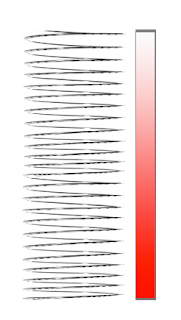


In a nicely preserved, non-faded print, the full range of the dye is visible.  Using a red, gradient yardstick (meterstick for you enlightened metric thinkers) to represent the full normal range that should have been captured when the print was created, the slinky is stretched so that the the bottom of it is attached to the 0 position on the stick, and the top of the slinky is at the 100% top.  All the loops of the slinky are evenly distributed from top to bottom. (Note to engineers and physicists...there is no gravity in my slinky-dye world.)


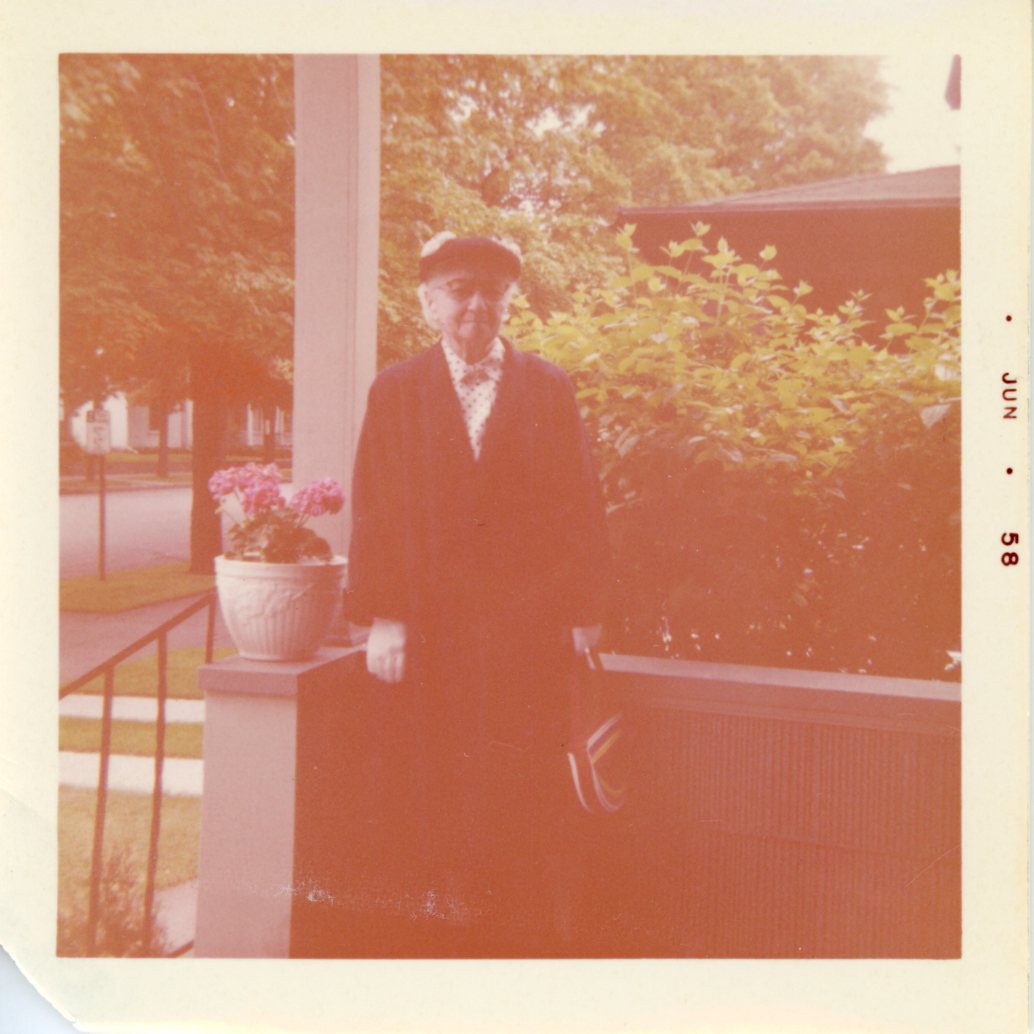
Very nice.  Great-Grandma looks wonderful, doesn’t she?  But then time goes by. You must remember this.  A kiss is just a kiss. And time will fade the dye….****


Great-Grandma on her porch in Wausau, Wisconsin.


A mere 60-or-so years and everything is tinted red.  And it has nothing to do with politics.


What’s happened to our Red Slinky?  Both the bottom and the top of the slinky have come unhooked from the ends of the stick.  And you know what happens when you unleash a stretched slinky. It gets smaller. It shrinks.  What used to be deep red is now a middling red because the bottom of the slinky has shrunk up to somewhere near the center of the stick.  What used to be white at the top of the slinky has shrunk down to where it is a little pink. Our slinky used to cover the full range, but time has changed it so that it only goes from the low end “sorta” red to a high end “kinda” pink.  This color nomenclature is an international standard. Crayola doesn’t use these terms because they are too technical.


But it’s not just our red slinky that has been affected by time.  Both the Blue and Green Slinkies have also come unhooked. The shrinking is similar, but not as bad.  The bottom of the Green Slinky stays almost hooked, but the top moves down a bit. The Blue Slinky does the same, but the top moves farther down toward the middle.


So the red moves way up toward white, and both the green and blue move toward dark.  And the print ends up with a reddish cast, particularly where it should be close to white, like on white shingles.  Also, that sky that should be brilliant light blue is now mauve, because the blue dye has faded more than the red in that area.


Gotta love a parade.
Would love it more with proper colors.


What do do, what to do!?!  Use Vivid-Pix RESTORE software to correct the images after scanning, of course, but also, let’s try to make sure the prints never get to this point, or at least don’t get any worse.


But that’s the subject of another post, which is coming soon, if I don’t fade away.


*Yeah, I know, newspapers usually fade to yellow.  That’s why the example is a picture of the clipping.


** The strict definition of “fade” is to become more faint and eventually disappear.  This is happening, but there is also something else going on. Color tints result from unequal fading in the different colors.


*** As with any analogy, the slinky dyes are not 100% analogous.  There are additional factors including the difference between reflectance and illuminance, scanner auto exposure algorithms, reciprocity, and the human visual system response to color.  You didn’t really want to read about all of that, did you? Good. I didn’t want to write about it, either.


**** “Play it, Sam.”

Great-Grandma much more as I remember her,
after using Vivid-Pix RESTORE.
Love the purse.